FundedNext is one of the few prop firms that sells both CFD and futures challenges under one name, and the two are different products, not two skins of one. CFD challenges (Stellar) measure targets and limits in percentages, trade forex, metals, energies, indices and crypto on MetaTrader or cTrader, and refund the fee on most routes. Futures challenges trade exchange-listed contracts, measure everything in dollars, use end-of-day trailing drawdown, cap each withdrawal, and are where all three of the firm’s discount codes sit. This page sets out the real differences between CFDs and futures at FundedNext so a trader can pick a side before picking a program. FundedNext is a prop trading firm, not a broker, so both are futures prop trading challenges or CFD challenges on simulated capital, and the trading platforms differ more than the prices.
By Priya Natarajan · Checked 11 October 2026
Futures vs CFDs at FundedNext: the key differences for a prop firm trader
| Feature | Stellar CFDs | FundedNext Futures |
|---|---|---|
| What you trade | CFDs on currencies, metals, energies, indices, crypto, stocks | CME-listed contracts (FundedNext also lists NYMEX and COMEX) |
| Platforms | MetaTrader 4, MetaTrader 5, cTrader, Match-Trader | Tradovate and NinjaTrader (TradingView also listed) |
| Targets and limits | percentages of the account | fixed dollar amounts |
| Drawdown | static on challenges (trailing on Instant) | end-of-day trailing on every program |
| Position size | leverage per asset class | contract limit per size |
| Reward share | 80% to 95% | 80% to 95% |
| Withdrawal cap | none printed | $800 to $1,500 per cycle |
| Fee refund | 2-Step, 1-Step, Lite | none shown |
| Published promo code | none | FNFLEX, RAPID, FNDIRECT |
| Cheapest entry | $32.99 (Lite $5K) | $69.99 (Flex $50K with code) |
| Skip the challenge | Stellar Instant | Futures Direct |
Futures trading vs CFDs: trading instruments, brokers and exchanges
A CFD (contract for difference) tracks the price of an underlying market without a fixed contract size or expiration dates, which is why forex traders size it in lots and leverage. A futures contract is a standardised exchange contract with a set size and an expiration date, and traders size it in contracts: minis and micros, such as a micro on the E-mini S&P 500 futures. In CFD and futures trading alike, which suits you depends on the trader’s market, not on the firm. FundedNext describes CFDs as a way to “Trade price movements across currencies, metals, energies and indices”, while futures are standardized contracts: “exchange listed contracts on CME, NYMEX, COMEX & more”. CFD brokers usually offer CFDs over the counter, and CFDs offer flexible position sizes; futures trade on an exchange such as the CME. At FundedNext, which says it is not a broker, both are simulated, but the rules follow the instrument, so the differences between CFDs and futures show up in every rule card. Commodity exposure, for example, comes as a commodity CFD with 1:15 leverage on Stellar, or as an energy or metal contract on futures.
Differences between futures and CFDs: how the prop firm measures the rules
On a CFD challenge every rule is a percentage. The Stellar 2-Step asks for 8% in phase one and 5% in phase two, with a 5% daily and 10% maximum loss limit; the 10% is measured from the initial balance and the drawdown is static, so the floor does not rise as you profit.
On a futures challenge every rule is a dollar figure, and the floor follows you. Flex $50K asks for $2,500 with a $1,500 maximum loss that trails your end-of-day balance. A trader who is up $1,000 at the close has a floor $1,000 higher the next morning. That is the biggest practical difference between the two sides of FundedNext: a static floor rewards building a cushion, a trailing one punishes giving profit back. For risk management, futures trading at FundedNext means watching the closing balance as much as the open trade; to trade CFDs on Stellar means watching the daily loss limit against the initial balance.
Leverage vs contract limits in futures and CFD trading
CFD traders size by leverage. On the Stellar 2-Step that is 1:30 on forex, 1:10 on indices, 1:15 on commodities, 1:1 on crypto and 1:2 on stocks.
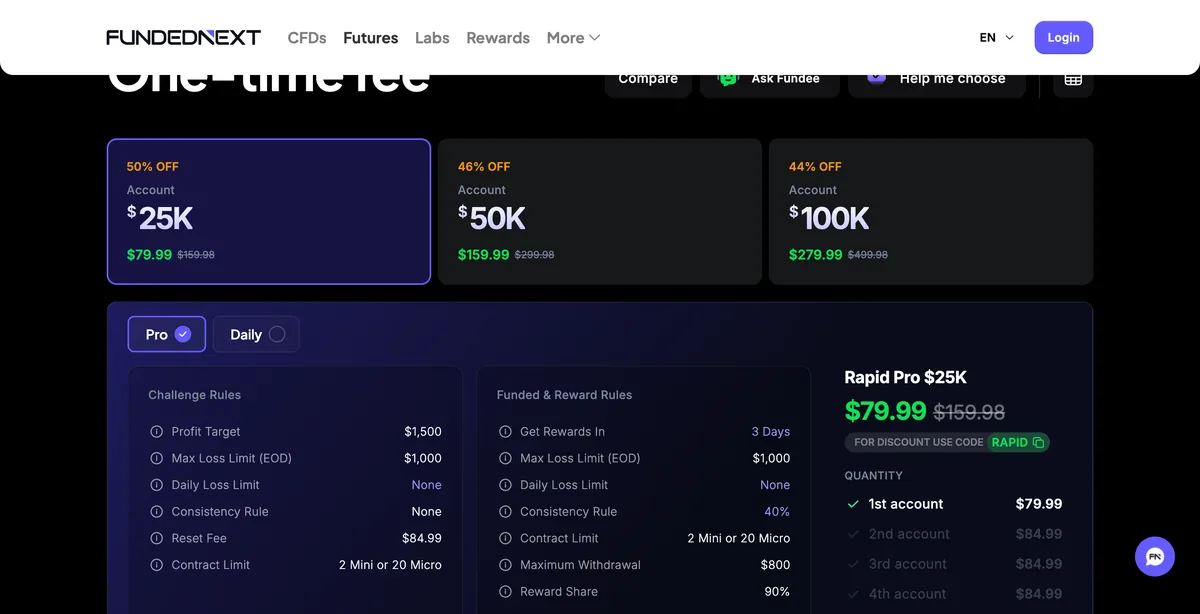
Futures traders size by contracts. Flex $50K allows 3 minis or 30 micros, Rapid Pro $25K 2 minis or 20 micros, Bolt $50K 3 minis or 9 micros, Direct $50K 3 minis or 30 micros. There is no leverage figure because a futures contract carries its own size.
Trade CFDs or trade futures: the platforms on each side
FundedNext’s platforms page lists four for CFDs: MetaTrader 5, MetaTrader 4, cTrader and Match-Trader. Automated trading is allowed only on MetaTrader, and an EA usage fee applies. The futures side trades on Tradovate and NinjaTrader, and the how-it-works page also lists TradingView. US residents should note that MT4, MT5 and cTrader are marked “Not available for USA clients”; Match-Trader is available to them.
Rewards on each side
| Feature | Stellar CFDs | Futures |
|---|---|---|
| Fastest first reward | 5 business days (1-Step) | daily once eligible (Rapid Daily, Bolt) |
| Usual cadence | every 14 days, or 5 business days on 1-Step | every 5 days to daily |
| Cap per withdrawal | none printed | $800 to $1,500 |
| Highest share | 95% (1-Step) | 95% (Flex) |
Futures pays more often and caps each payment. Stellar pays less often and caps nothing in the page text. The full schedule, payout methods and FundedNext’s 24-hour promise are on our page on how FundedNext pays out.
Start trading: what each FundedNext challenge costs
A $50K Stellar 2-Step costs $299.99 and refunds it with the first reward. A $50K Flex costs $69.99 with the code FNFLEX and refunds nothing, but a reset costs $77.99. A $50K Direct account costs $169.99 with FNDIRECT and has no challenge at all. The cheapest $50K route at FundedNext is therefore a futures challenge, and the cheapest net route for a trader who expects to be paid is a Stellar challenge with a refund. Every size and price is on our FundedNext pricing page; the three futures codes are on our FundedNext discount codes.
Why traders choose futures, and why traders choose CFDs for prop trading
Traders choose Stellar CFDs if they:
- trade forex, gold, oil, indices or crypto CFDs and already use MetaTrader or cTrader;
- want a static floor that does not trail their profits;
- want the challenge fee back;
- want to run an Expert Advisor (MetaTrader only, with a fee).
For forex trading, the choice is made for you: forex is a Stellar CFD market, and the futures markets FundedNext lists are exchange contracts. For index and commodity traders both sides work, and the right trading strategy decides it: day trading that closes flat each day is hit less by a trailing floor than swing trading that holds positions through pullbacks.
Traders choose futures if they:
- trade index, energy or metal futures and think in contracts rather than lots;
- want frequent, capped payouts;
- want the cheapest entry and are happy to use the firm’s code;
- want to start funded with no challenge (Direct);
- are comfortable with an end-of-day trailing drawdown.
What futures and CFDs share at FundedNext
On both sides the funded accounts are simulated. The company, the support, the reward methods (USDT, USDC, RiseWorks), the virtual-capital model, the restricted countries and the one-time fee apply to both. So do the inconsistencies we found on the firm’s own pages, listed in our list of where FundedNext’s pages disagree. The records on the company itself are on our is FundedNext legit page.
Frequently asked questions
Is futures or CFD trading better at FundedNext?
Neither is better in general. Futures is cheaper to enter and pays more often with a cap; CFDs refund the fee, have a static floor and allow EAs on MetaTrader.
Can I trade forex on FundedNext Futures?
FundedNext Futures trades exchange-listed futures contracts, not forex CFDs. For forex CFDs, the Stellar challenges are the route.
Does FundedNext Futures have a daily loss limit?
Flex and Rapid Pro have none. Rapid Daily, Bolt and Direct do: $1,000 on $50K, a “soft breach” on Bolt and Direct.
Which FundedNext side has a promo code?
Only futures: FNFLEX on Flex, RAPID on Rapid Pro and FNDIRECT on Direct, on 11 October 2026.
Can US traders use both?
The firm runs a separate US section. On the CFD side only Match-Trader is listed for US clients.